
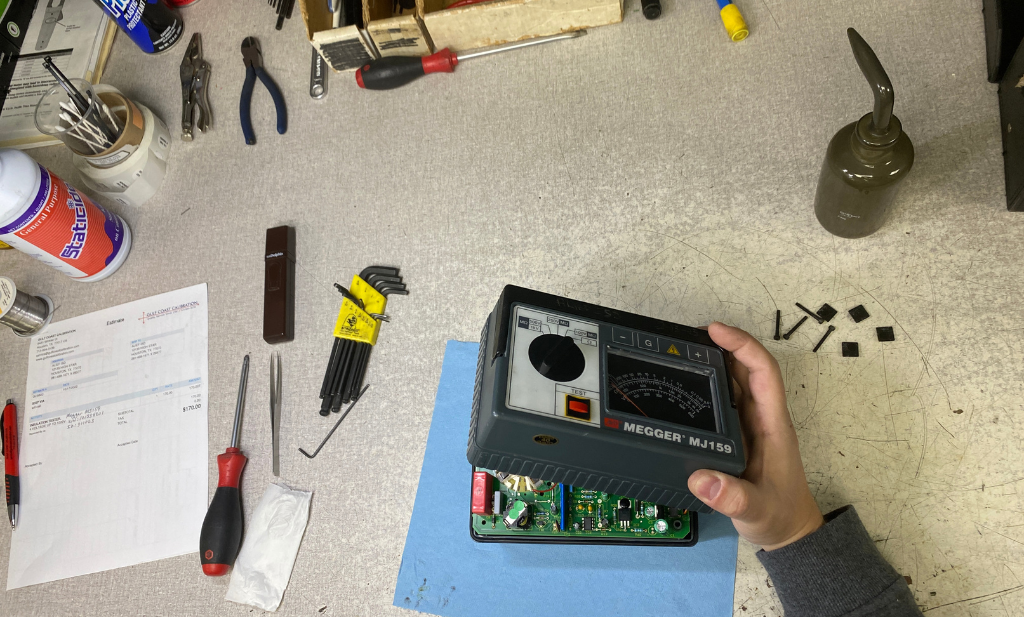
10 Reasons to Calibrate your Instruments with Gulf Coast Calibration

by gcc-admin-alpha

Is it more essential to be accurate or timely?

You get both when you work with Gulf Coast CalibrationA2LA-accredited calibrations lab.

Gulf Coast Calibration has been committed to producing the finest, high-precision pressure measurement and calibration systems available since 1981 â€“ it is this international reputation for quality and service that meets your requirements for both timeliness AND accuracy.

We understand your industry and business. We support a wide range of systems in addition to our own. We understand the distinction between process time and lead time, and we guarantee 5-day or less in lead time.

Why Should You Calibrate?

The reasons for calibrating are simple. Component, equipment, and product calibration can:

  1. Spend less money:
    Profits will rise if costs and waste are reduced through standardization.
  2. Ensure Your Safety:
    Products and components that have been calibrated work as expected and are safe to use.
  3. Ensure High Quality:
    Calibrated components and equipment will consistently create standardized products.
  4. Reduce Production Time:
    When high-quality components are available, there is no need to waste time changing out-of-spec components.
  5. Ensure Certification Compliance:
    It is guaranteed that industry rules and corporate certifications are followed.
  6. Ascertain Accuracy:
    Calibration will enable consistent reporting of product correctness.
  7. Allows for traceability:
    If necessary, calibrations can be undertaken with traceability to national standards.
  8. Improve consistency and dependability:
    Products that are manufactured to specifications perform better and endure longer.
  9. Make up for Drift:
    Regular calibration eliminates drift error.
  10. Process Failures Can Be Prevented and Predicted:
    Sensors that are reliable and precise can identify a gradual shift toward out of tolerance process conditions.

How Often Should You Calibrate?

Calibration, at its heart, is a method for determining the best approximation of the real value of a quantity being measured. There is no way to determine the exact value of a measurement, but it is feasible to come close. This proximity to the truth is what we call accuracy. Calibration is a method of ensuring that measurements collected from a device are accurate. This is accomplished by comparing the device output to a more accurate reference device. Best practices necessitate that this reference device be traceable to a national or international standard in SI units.

Some sensors wander more than others. Manufacturers typically have a reasonable notion of how long a sensor will take to drift out of tolerance. A “calibration interval” will be recommended by a manufacturer based on their expertise and the inherent calibration stability of a sensor. The calibration interval is often specified in the sensor’s specifications. The term “recommendation” indicates some freedom in extending or shortening the period based on an individual sensor’s continuing history. Some sensors may remain in tolerance for a longer period of time than others. In practice, the user must decide whether to re-calibrate depending on their experience with each sensor.

Call us to discuss your calibration, test or repair needs at:
713.944.3139.

Request for Calibration Quote

Request for PPE/Glove Testing Quote

10 Types Of Dimensional Inspection Hand Tools And When To Use Them

by gcc-admin-alpha

Any quality control procedure would be incomplete without the use of hand tools for dimensional inspection. They are used to check if a product or part satisfies the necessary requirements by measuring and inspecting various product or part dimensions. In this post, we’ll look at 10 different kinds of hand tools for dimensional inspection and discuss when to use each one.

1. Calipers:

Calipers are used to measure the distance between two points, as well as thickness and diameter. They are used in a variety of industries, including metalworking, engineering, and woodworking.

2. Micrometers:

Micrometers are used for measuring small distances, thicknesses, and diameters. They are extremely precise and widely used in industries such as manufacturing and quality control.

3. Height gauges: 

Height gauges: Height gauges are used to measure an object’s height, including its vertical distance from a reference plane. They are useful in industries such as construction and manufacturing.

4. Depth gauges:

Depth gauges are used to determine the depth of a hole or recess. They’re useful in woodworking, metalworking, and other industries that require precise depth measurements.

5. Thread gauges:

Thread gauges are used to determine the pitch, diameter, and thread angle of screws, bolts, and other threaded objects. They are used in the manufacturing and quality control processes.

6. Feeler gauges:

Feeler gauges are used to determine the clearance or gap between two parts. They are widely employed in the automotive and aerospace industries.

7. Dial indicators:

Dial indicators are used to determine the distance or movement of an object. They are frequently employed in machining and manufacturing.

8. Surface roughness testers:

Surface roughness testers: These devices are used to determine the roughness or smoothness of a surface. They’re common in industries like automotive and aerospace.

9. Radius gauges:

Radius gauges are used to determine the radius of a curve or surface. They are widely used in woodworking, metalworking, and other industries where precise curve measurements are required.

10. Bore gauges:

Bore gauges are used to determine the diameter of a hole or bore. They are widely used in manufacturing and quality assurance.

The type of measurement required and the industry in which it will be used determine which dimensional inspection hand tool to use. Each tool has advantages and disadvantages, and choosing the right tool is critical for precise measurements.

It is essential to comply with best practices for using dimensional inspection hand tools in addition to knowing which tool to use. Here are some pointers to remember:

Select the appropriate tool for the job: As previously stated, each tool has advantages and disadvantages. When selecting the appropriate tool, consider the type of measurement required as well as the industry in which it will be used.

Zero the tool before use: To ensure accurate measurements, zero the tool before use. When no measurements are being taken, the tool is set to read zero.

Use the tool correctly: Each tool comes with its own set of instructions for use. Follow these steps to ensure precise measurements and avoid damage to the

It is essential to comply with best practices for using dimensional inspection hand tools in addition to knowing which tool to use. Here are some pointers to remember:

  • Select the appropriate tool for the job: As previously stated, each tool has advantages and disadvantages. When selecting the appropriate tool, consider the type of measurement required as well as the industry in which it will be used.
  • Zero the tool before use: To ensure accurate measurements, zero the tool before use. When no measurements are being taken, the tool is set to read zero.
  • Use the tool correctly: Each tool comes with its own set of instructions for use. Follow these steps to ensure precise measurements and avoid damage to the tools.
  • Clean and maintain the tool: Cleaning and maintaining the tool on a regular basis will ensure that it remains accurate and reliable. Follow the cleaning and maintenance instructions provided by the manufacturer.
  • Regularly calibrate the tool: Even with proper use and maintenance, dimensional inspection hand tools can lose accuracy over time. Calibration on a regular basis can ensure that the tool remains accurate and reliable.

The type of measurement required and the industry in which it will be used determine which dimensional inspection hand tool to use. Each tool has advantages and disadvantages, and choosing the right tool is critical for precise measurements.

You can ensure that your dimensional inspection hand tools provide accurate and reliable measurements by following these guidelines. To get the best results, choose the right tool for the job, use it correctly, and maintain it on a regular basis.

Conclusion

Finally, dimensional inspection hand tools are critical for quality control in a wide range of sectors. Knowing which tool to use and how to use it accurately can help ensure that your measurements are precise as well as consistent. You can ensure that your quality control process is effective and efficient by following best practices for using dimensional inspection hand tools.

Call us to discuss your calibration, test or repair needs at:
713.944.3139.

Request for Calibration Quote

Request for PPE/Glove Testing Quote